8 March 2026

Grumman F4F-4 Wildcat Model

1. Introduction
1.1. Aircraft
Grumman F4F-4 Wildcat
Carrier-based fighter (information in Wikipedia)
U.S. Navy. VF-9 squadron.
USS Ranger (CV-4), off the coast of Morocco, November 1942.

1.2. Story
An F4F-4 Wildcat of Fighter Squadron Nine sits aboard the USS Ranger somewhere during November 1942. The flight deck crewmen finish the process of unfolding the Wildcat's wings, preparing it for flight. At that time Ranger was a part of a large naval force assembled for the Operation Torch, an Allied invasion of the North Africa during the World War II.


1.3. Model Kit
F4F-4 Wildcat from Arma Hobby (kit # 70047), 1:72 scale.

2. Kit Overview
This is one of the best 1:72 scale model kits that I have handled. Its accuracy is superb. The kit requires neither aftermarket items nor any scratch-building. This is the first time that I see an 1:72 model kit that, out of the box, does not need any additional detailing in either the cockpit or the landing gear or the engine. The comprehensive multi-color instruction booklet also deserves praise.
In regards to the plastic, some minor issues – as I see it – are as follows:
 - The wing halves, when joined, result in a very thick trailing edge that will need addressing.
 - The panel lines are a bit too subtle / too shallow.
 - The manufacturer could have provided us with transparent parts for external navigation / position lights – these would have been very easy to mold in plastic and would not have required more material than, say, the plastic machine gun barrels that are included in the box. Alas, hardly any model kit company would do this very simple thing.
The low point of this kit is the enclosed decal. At first glance, the decal is accurate and generous (10 marking options in total). Unfortunately, a serious problem pops up when you actually try to apply the decal: it is very stiff, it refuses to properly adhere to curved surfaces (such as the curves of the rear fuselage spine) and refuses to "sink into" recesses even when treated with decal setting solutions.
Photographs of the kit's content can be found inside the reviews referenced on the respective page at Scalemates.

3. Construction
3.1. Building


When building my model, I made the following modifications worth listing:
 1) The Wildcat has a very interesting and unusual way of folding the wings – a uniquely Grumman's design. I wanted to showcase this by presenting the wing in the process of being unfolded by the flight deck crew. To model this, I have attempted to use a resin aftermarket set produced by CMK. This set has good detail, but suffers from poor fit and poor sizing, so that eventually around half of the set's details had to be modified or re-created through scratch-building. This was the most tedious of all modifications, but it was "self-inflicted", since the kit, of course, could very well have been built with both wings unfolded.
 2) Arma Hobby has designed an excellent rendition of the Wildcat's immensely complicated landing gear and the respective fuselage compartment. All key elements are provided in plastic. They were quite right not to attempt to replicate an impossible tangle of tubing and wiring that is also present in this compartment on a real Wildcat. I have tried to add at least some of the tubing, but despaired: nothing more could be done in this scale.
 3) On a real Wildcat, you cannot look into one of the lower fuselage windows and see right through to the other window because the central fuel tank is in the way. There is no need to replicate the fuselage interior fully, but at a least a shape resembling the tank should be installed to block this "see-through" effect on your model.
 4) Machine gun barrels were made from thin metal tubes, and a sketchy imitation of the gun camera window was added (left wing leading edge).
 5) Trimmer push rods were imitated for the elevators, the rudder and the left aileron.
 6) At the aft end of the fuselage, some details were added to show the arrestor hook head and the catapult holdback attachment point.
 7) Painting the solid plastic red or green or blue to imitate the navigation / formation lights is unacceptable, in my view. Therefore, all lights had to be done from clear plastic. These include: a) red and green wingtip navigation lights; b) clear blue formation lights on the upper sides of both wings; c) clear blue and clear white lights on top of the fuselage. In addition to this, there is an opaque white light at the aft end of the fuselage. The wing-mounted clear landing light is provided for in the kit.
 8) Dorsal wire aerial was imitated. Note that there must be no wires (shown on many drawings) between the fuselage sides and the horizontal stabilizers of an operational carrier-based Wildcat.


3.2. Painting & Markings
My Wildcat wears the standard Blue Gray over Light Gray U.S.Navy color scheme of the period (good historical photo showing this color scheme: link). The aircraft involved in the Operation Torch had a yellow outline around their fuselage and lower wing national insignia. At that time, the Wildcats of the VF-9 from the USS Ranger still had their full squadron codes on the fuselage sides. This is the photograph of the "9-F-12" that I have replicated: link. The national insignia decals came from a generic sheet produced by Techmod, and for the squadron codes I used the kit's decals.
The Arma Hobby's instruction booklet provides good and detailed painting guidance. However, at least one thing needs correction: most of the subject matter experts have, by now, came to the agreement (e.g. look for comments from Dana Bell) that the cockpit interior color on the F4F-4 was Bronze Green and not Interior Green.

3.3. Presentation
My F4F-4 is shown positioned on the carrier flight deck. The crewmen finish the process of unfolding the plane's wings, preparing it for flight (the Wildcat's wings were folded and unfolded manually, one after another; the ailerons, with the wing folded, always pointed upwards).
As to the crew figures, to get the desired poses and attire, I had to combine torsos, legs, arms and heads from several old sets – Fujimi, Hasegawa, CMK and Airfix.

4. Reference Data
[1] General information on the Grumman Wildcat in Wikipedia: link
[2] F4F Wildcat in Action | Aircraft in Action Series # 191 | Squadron/Signal Publications, 2004.
[3] F4F Wildcat Walk Around | Walk Around Series # 4 | Squadron/Signal Publications, 1995.
[4] F4F Wildcat in Detail & Scale | In Detail & Scale Series # 65 | Airlife Publishing Inc.

18 June 2025

Douglas A-4C Skyhawk Model

1. Introduction
1.1. Aircraft
Douglas A-4C Skyhawk
Carrier-based attack aircraft (information in Wikipedia)
U.S. Navy. BuNo 149574 / NL306. VA-153 squadron.
USS Coral Sea (CV-43), Gulf of Tonkin, 1964.


 1.2. Story
An A-4C Skyhawk jet of Attack Squadron 153 aboard the USS Coral Sea sits armed and chained to the flight deck. The flight deck crew prepare the plane for the next mission. 


1.3. Model Kit
A-4C Skyhawk from Fujimi (kit # F-26 / 25026), 1:72 scale.

2. Kit Overview
The Skyhawk kit by Fujimi is well-known. Although quite old by now (first introduced in 1987), the kit is, in my view, exceptionally good for its age. The accuracy and the quality of moulds are excellent, and the fine surface details are better than on many newer kits. The following features of the Fujimi's kit are, for me, especially commendable:
 1) Fujimi has correctly modelled one of the most noticeable features of the tiny Skyhawk: the extended leading edge slats. Those leading edge slats are entirely automatic and are controlled solely by aerodynamic forces; there are no provisions for the pilot to control the slats. They automatically extend (fall down due to gravity) when the airplane slows down for landing, they remain extended on the ground and throughout the takeoff, and then they automatically retract when the airplane reaches a certain airspeed (and the wind speed overpowers the gravity). Any scale model that is intended to represent an operational Skyhawk – on the ground or on the flight deck – must have the leading edge slats extended.
 2) Engine intake interior is included (which wasn't a common practice for the 1:72 scale kits back then).
 3) Quite decent landing gear detail is provided (wells, doors, legs).
Yet, the kit is not perfect: the cockpit interior and the main wheels need replacement, some of the features on the fuselage are incorrect for the A-4C variant, and a number of small details are lacking (and should be scratch-built if your aim is to have an accurately looking A-4C).


3. Construction
3.1. Building
 
 
This is the list of enhancements that I have added to what was in the box:
 1) A number of small inlets and vents on the fuselage were cut out so as to accurately represent the A-4C variant (this kind of detail on the Fujimi's central fuselage parts is mostly correct for the A-4E/F variant). Gun blast shields were removed altogether as absent on the real A-4C.
 2) To improve the cockpit, a resin set by Aires was installed. It offers amazingly detailed ejection seat, instrument panel and side consoles. Note, however, that most items have to be trimmed to fit, and the set's gunsight installation cannot be used due to insufficient space (the cockpit of the plastic Skyhawk is even more cramped than the cockpit of the real one, and the thickness of the plastic windshield precludes anything of significance to rise above the instrument panel hood).
 3) Wing leading edge slats are positioned as extended, which is necessary for operational Skyhawks when on the ground / on the flight deck. The channels for the slat actuators, lacking on the kit's upper wing, had to be scribed. Also, the relief on the inner surface of the slats was imitated.
 4) Wing flaps are positioned as extended, which is normal for operational Skyhawks at rest.
 5) Scratch-built actuators added for ailerons and aileron trim tab.
 6) Landing gear well interior and landing gear legs enhanced with some minor scratch-built details. This included tie-down rings, brake lines and metal oleo for the nose landing gear leg.
 7) Correct main wheels added, using a resin aftermarket set by Pavla.
 8) The small fuel dump pylon under the right wing must stand much closer to the flap hinge line than it is on the Fujimi's kit. A new one was scratch-built.
 9) As usual, external lights required much work – in the 1:72 scale the kit manufacturers typically ignore this aspect. For the A-4C, the following has to be done: a) clusters comprising three lights on each of the wing tips; b) approach light in the left wing root; c) dorsal navigation light; d) ventral navigation light under the left wing; e) landing light on the right main landing gear door; f) in-flight refuelling probe illumination light on the right air intake lip.
 10) Several other small items were scratch-built and installed: a) gun barrels; b) Pitot tube & temp. probe; c) AoA vane; d) windshield wiper; e) several blade antennas; f) catapult bridle hooks.
 11) Ordnance was added in the form of two AGM-12B missiles manufactured by Eduard. Such load is confirmed by historical video footage of the VA-153 Skyhawks (link).
Speed brakes are of course closed, as it should be on an operational Skyhawk in normal conditions.
Note that at that point of time, the A-4Cs belonging to this particular squadron did not have any ECM antennae fairings, nor the flare & chaff dispensers. Also note that the Bullpups were attached to the pylons directly, without adaptors.
 
3.2. Painting & Markings
The aircraft wears the standard U.S.Navy Light Gull Grey over Insignia White camouflage scheme of the period. Miscellaneous markings applicable for this particular machine (149574 / NL306, seen e.g. here) are done in accordance with historical photographs and comprise:
 - Insignia Red engine intake lips and wing flap interior. Note that the red is absent from the leading edge slats interior and landing gear door edges.
 - Black anti-glare panel (in front of the canopy) and nose cone.
 - Aluminum-colored leading edges of the wing, the horizontal stabilizer, the tail fin and the weapon pylons.
 - Bare metal (steel) engine exhaust pipe and the tips of the refueling probe and the arrestor hook.
 - The squadron's trim consisting of the light blue vertical stabilizer with white diagonal stripes, separated from the fuselage by a very thin black border.

The decal from the Fujimi's box is accurate (which was not very common 40 years ago and is not guaranteed even now), but is let down by two things: the carrier film is very thick and the stuff that should be white is printed instead as cream-colored. However, I wanted a different variant in any case – a VA-153 bird with that colorful blue tail. To accurately represent a VA-153 Skyhawk from a 1964-1965 deployment, I had to have some of the markings made as a custom-printed decal. The national insignia decals came from a generic sheet by Techmod, and only some miscellaneous markings (such as the anti-glare panel) were used from the kit's decal.

In decaling a U.S. Skyhawk, there are two issues that are rarely mentioned. Firstly, the upper surface of the wing is studded with turbulators, and the Navy inconveniently painted both the national insignia and the wing codes right over these items. No decal will adhere to such a relief. Therefore, the turbulators have to be removed from the respective areas, and then, after painting and decaling, you carefully glue the tiny pieces of thin plastic you've made yourself and brush-paint every one of them. Secondly, the right hand side fuselage national insignia on the A-4B and C variants goes over the prominent bulge containing the in-flight refuelling tubing. The standard national insignia piece from a kit or an aftermarket decal cannot cover this bulge, therefore you have to improvise again (e.g., to cut the standard n.i. piece into two parts and to fill the gap by some paintwork).

3.3. Presentation
My small diorama shows the Skyhawk being prepared for flight and includes the following:
 1) The deck imitated with sheet plastic was detailed with photo-etched tie-down eyes.
 2) The flight deck crew figures were obtained from several sources (Italeri, Airfix, Hasegawa), and all of them underwent "plastic surgery".
 3) External electric power for pre-flight purposes comes from the NC-1A mobile power unit, a special vehicle in wide use on the U.S. Navy aircraft carriers between the 1950 and the late 1960s.
 4) Early variants of the Skyhawk (specifically, the Wright J65-engined A-4A, B and C) utilized a very peculiar engine start arrangement: the engine had to be started mechanically by means of a rotating metal shaft inserted into a dedicated receptacle from the outside, and the shaft, in turn, was driven by compressed air obtained from a tractor-mounted jet start unit. On my vignette, an MD-1 flight deck tractor equipped with an air start unit backs to the airplane, while a ground crewman hauls a portable device that "converts" compressed air energy into mechanical rotation.
 5) Any aircraft parked on the flight deck must be secured to the said deck. This is a very strictly followed rule: if there is no pilot (or crewman) in the cockpit to operate the brakes, the aircraft is always tied down. On my vignette, a photo-etched metal imitation of tie-down chains is used; these chains are flat, but they are better than nothing.
 6) The Skyhawk was one of the very few Navy airplanes lacking the self-boarding capability, so that external access ladders were always needed to get to the cockpit. A photo-etched metal ladder was therefore added to my Skyhawk.
Here's an excellent photograph that shows a number of peculiar features mentioned above, namely, the access ladder, the tie-down chains, the starter probe (inserted into its receptacle), and also the way the right-side national insignia is painted over the IFR tubing: link.
  
 
With the exception of photo-etched tie-down chains which came from an old aftermarket set by White Ensign Models, all of the support equipment mentioned above was designed and custom-made by myself.

4. Reference Data
[1] General information on the A-4 Skyhawk in Wikipedia: link
[2] A-4 Skyhawk in Detail & Scale | In Detail & Scale Series # 32 | Airlife Publishing Inc., 1989.
[3] U.S. Navy and Marine Corps A-4 Skyhawk Units of the Vietnam War | Combat Aircraft Series # 69 | Osprey Publishing Ltd., 2007.
[4] A-4 Skyhawk Walk Around | Walk Around Series # 41 | Squadron/Signal Publications, 2006.
[5] A collection of historical photographs accumulated over the years of browsing various galleries on the Internet.
 
5. Notes
5.1. Note that the Skyhawk (and it is not unique in this regard) has a number of painting and marking peculiarities, and even the machines of the same version from the same squadron may differ. For instance, there are several variations of applying the jet intake warning chevrons. The aluminum anti-corrosion paint on the leading edges, the red paint on the slats interior and the landing gear door edges may or may not be present. Various shapes and colors of the wing walkways have been observed, while in some cases they were absent altogether. Similarly, the size and positioning of the wing codes varied. And so on.
This kind of information is nearly always omitted in the kit manufacturer's instructions. You have to do your own research, to be based on historical photographs, and not on how the museum exhibits are painted, nor on various artworks or color profiles found in aviation magazines.

5.2. Regarding the Bullpup missiles. The Internet is full of line drawings and 3D-renderings which are labeled "AGM-12B", but are grotesquely inaccurate when compared to the real thing. So beware. Your trust should be put in the historical photographs only.
This kind of analysis tells us that the one-piece missiles included with the Fujimi's Skyhawk kit are hopelessly inaccurate. On the other hand, aftermarket AGM-12B missiles manufactured by Eduard are good shape-wise. Still, the Eduard's set is not without some problems. The way the resin parts are molded makes their removal from their respective bases and the eventual assembly of each missile needlessly complicated. Then, if you follow the instructions, you will get a missile in a non-operational configuration, with its exhaust pipe closed. Also note that there were several different variations of markings on the missile body (the painted rings in particular, as well as various stenciling), as can be seen on the photographs of real AGM-12Bs hanging under real warplanes.

8 September 2024

Grumman F9F-8 Cougar Model

1. Introduction
1.1. Aircraft
Grumman F9F-8 Cougar
Carrier-based fighter / fighter-bomber (information in Wikipedia)
U.S. Navy. BuNo 141123 / E208. VF-61 squadron.
USS Intrepid (CV-11), at sea, 1956.


1.2. Story
An F9F-8 Cougar jet of Fighter Squadron 61 aboard the USS Intrepid is on the carrier's catapult, ready to be launched on a routine training mission.

1.3. Model Kit
F9F-8 Cougar from Hasegawa (kit # 01619), 1:72 scale.

2. Kit Overview
The kit is very old (reportedly first tooled by Hasegawa in 1978) but surprisingly accurate for its age. The quality of moulds and the overall geometry are very good. The list of noticeable inaccuracies (the ones that must be corrected) is not very long; it includes main wheels; speed brake panels; aft end of the horizontal stabilizer fairing; IFR probe tip. Also, the layout of parts does not allow, without some surgery work, to build an early variant – the one without the intake splitter plates.
As it is typical with Hasegawa, there isn't much either in the cockpit or inside the wheel wells. A number of small details found on a real F9F-8 are missing too, but that is to be expected for a kit this old.

3. Construction
3.1. Building
This is the list of enhancements that I have added to what was in the box:
 1) Various fuselage inlets and vents were cut out (indents plus dark wash would not suffice to realistically imitate these, in my view). One incorrect inlet (fuselage rear, bottom right side) was filled. A couple of bulging inlets were also added.
 2) Some plastic surgery had to be done to the engine intake channels and fuselage sides in order to represent an early Cougar without the intake splitter plates.
 3) An excellent aftermarket cockpit set was installed (set # 7205 by the Czech firm CMR), comprising resin and photo-etched parts to give adequate cockpit and under-canopy detail.
 4) The tail end of the fairing of the horizontal stabilizer must be made taller – and slimmer – than it is on the kit (o → 0).
 5) My Cougar was to be presented as ready to be launched – on a catapult, with its engine running. Therefore, the two pairs of auxiliary air intake doors on the upper fuselage had to be shown open. It also meant that at least a sketch of the interior visible through these doors had to be modelled (which, in the end, has turned out to be nearly invisible).
 6) On a Cougar before launch, both the outboard and the inboard flaps are lowered (a photographic proof: link). The cutting-out of the outer flaps was a relatively straightforward operation.
 7) For the lowered inboard flaps, the respectively revealed interior had to be scratch-built.


 8) The kit's main landing gear wells are too shallow. They had to be deepened for accuracy, and a sketch of interior was also added.
 9) Nose landing gear leg was entirely scratch-built, and the main landing gear legs were enhanced with some minor details (brake lines, tie-down rings).
 10) Correct landing gear wheels were taken from a resin set #7291 manufactured by Aires.
 11) Landing gear doors had to be scratch-built from thin plastic, as the respective kit parts are too thick.
 12) Custom-made photo-etched speed brake panels replaced the kit's inaccurate plastic items. The speed brakes are of course closed, as it should be on an operational, stationary Cougar in normal conditions.
 13) Scratch-built tail skid was added. Note that it is normally extended on a stationary Cougar.
 14) Wingtips were detailed with small round ram-air inlets (leading edge) and fuel vent outlets (trailing edge).
 15) Multiple other tiny items were scratch-built and installed: a) intricately shaped barrier guard; b) gun barrels; c) IFR probe tip; d) Pitot tube; e) catapult bridle hook and catapult holdback ring; f) tailhook; g) fuel drain pipe.
 16) As usual, external lights required much work – in the 1:72 scale the kit manufacturers typically ignore this aspect. For the Cougar, the following has to be done:
  a) clear white dorsal navigation light, teardrop shaped;
  b) opaque white and orange tail navigation lights, round;
  c) carrier approach lights cluster – port wing root only
  d) navigation lights – red and green coloured lamps inside clear wingtip caps;
  e) navigation lights – red and green teardrop shapes on wing upper sides;
  f) circular blue formation lights – wing undersides.

For amusement's sake, I counted all the bits that went into my model. The grand total is 195, 19 parts are from the Hasegawa kit, 30 parts are from aftermarket sets, and the remaining 146 pieces were scratch-made (using plastic, metal wire and metal foil).

3.2. Painting & Markings
The aircraft wears the standard U.S.Navy Light Gull Grey over Insignia White camouflage scheme of the period. Miscellaneous markings are done in accordance with historical photographs and comprise:
 - Aluminum-colored leading edges of the wing, the horizontal stabilizer and the tail fin.
 - Black anti-glare panel in front of the canopy.
 - Insignia Red intake lips and flap wells interior.
 - Grey wing walkways (a shade darker than Light Gull Grey, yet not as dark as Dark Gull Gray) with black outlines.
 - Bare metal jet exhaust pipe.
Also note the following peculiar aspects:
 - The horizontal stabilizer was painted Insignia White overall, and not just the elevators.
 - A separate wing trimmer tab was present only on the left wing and was painted Insignia White.
 - Black bands on speed brake panels.
 - Operational F9F-8 fighters did not have the landing gear door edges painted Insignia Red (this practice was only introduced in 1959).

The decal that comes inside the box is typical for "classic" Hasegawa kits: extra thick layer, white color printed as cream, plus some cracking due to old age. And in any case it doesn't cover the variant that I wanted – a VF-61 grey & white bird (the Hasegawa's decal is for a dark blue aircraft).
Therefore I had to use an aftermarket decal: it came from a multi-subject set #CTA-006 ("Jolly Rogers Timeline") produced by a small vendor named Cut then Add. In this set, the items intended for the F9F-8 are usable, although with a couple of issues. Firstly, the designer of this decal makes the same – unreasonable – premise as Hasegawa has done: that the decals intended to represent the yellow parts of the trim can cover such complex, curved shapes as the nose cone, the wing tips or the stabilizer fairing. That they definitely cannot. Therefore for the yellow trim you must use paint, and the decal will facilitate the thin black outline only (which is impossible to paint). Unfortunately, the thin black outline intended for the nose cone is incorrect (too small), and here I had to improvise with a piece of self-printed decal.
The national insignia decals came from a generic sheet produced by Techmod, as the blue on the CtA decal is too light.

3.3. Presentation
<to be detailed later>

4. Reference Data
[1] General information on the Grumman Cougar in Wikipedia: link
[2] F9F Cougar in Detail & Scale | In Detail & Scale Series # 16 | Aero Publishers Inc., 1983.
[3] Grumman F9F-6/7/8 Cougar | Naval Fighters Series # 66 | Ginter Books, 2005.
[4] Navy & Marine Fleet Single-Seat F9F Cougar Squadrons | Naval Fighters Series # 69 | Ginter Books, 2006.

5. Notes
5.1. Many modellers equip their Cougars with 4 Sidewinder missiles and 2 external fuel tanks – obviously, because this is what the kit manufactures are suggesting in their instruction sheets, and also because many model builders enjoy loading their creations with as many weapons as possible.
Yet there is no photographic proof that such load was actually carried by operational F9F-8 Cougars.
I have counted all photographs of operational F9F-8 Cougar fighters that I was able to find (from books like Naval Fighters, Squadron/Signal, In Detail & Scale and various online galleries): there are slightly more than 300, and only 1 photograph shows an operational Cougar with Sidewinder missiles (with just two AIM-9Bs, in fact). And no, this is not because the set of available photographs is not a representative one. This is because an operational Cougar with Sidewinder missiles was indeed a rarity.
The fact that aircraft type "A" was technically capable of carrying weapon (or, more broadly, external stores) load "W" does not automatically mean that this aircraft type "A", while serving with squadron "S" during time period "T", was in fact carrying this weapon load "W".
There are such things as: a) logistics (actual availability of particular weapons / stores); b) requisite training of personnel; c) specific tasks set for a particular unit (squadron).
The first operational AIM-9B missiles were received by the operational squadrons of the U.S.Navy in mid-1956. By that time the F9F-8 variant was not very old – it has entered squadron service in late 1954. But it must be remembered that from the point of view of the Navy's top brass, the Cougar as a type was an interim solution. It was only in service because the other fighter projects – the F7U Cutlass, F3H Demon and F4D Skyray – have been much delayed. The year 1954 saw the entry into service of the F7U-3M Cutlass, and the 1956 – of the FJ-3M Fury, F3H-2 Demon and F4D-1 Skyray. The Cutlass is outside our area of interest here, as it was only capable of carrying the Sparrow I missile, but the other three types were envisaged as missile fighters equipped with the Sidewinder (and also the Sparrow, in the Demon's case). The squadrons "coming online" with these new types waited for the missile, and its production, initiated only recently, could not obviously satisfy all units at once.
By that time, the F9F-8 was already perceived as a multi-role plane, with more emphasis put on its light attack capability. So by 1956 the F9F-8, while still in service with many squadrons, was already slated for replacement – either with the new types of fighters already mentioned, or with the new types of light attack planes, such as the FJ-4B Fury and the A4D-1 Skyhawk. After all, within each USN Carrier Wing there could only be a limited number of squadrons, because an aircraft carrier could only embark a given number of planes.
Thus, there was very little sense, at that point, to allocate the time and the resources (in particular, for respective personnel training) required to actually broaden the mission of each of the existing Cougar squadrons with that of a missile-fighter, even if the production tempo of the missiles was able to support this growth.
So the bottom line is this: it is most probable that very, very few of the operational squadrons flying the F9F-8 Cougar have ever received the Sidewinder. And it is most improbable that the VF-61 'Jolly Rogers' squadron – the one beloved by scale modellers, – which only flew the F9F-8 variant for a few months (between January and September 1956), has seen the Sidewinder missiles at all.

5.2. It is very sad to observe the decline of Hasegawa as a designer and manufacturer of aircraft model kits. Once, Hasegawa was a byword for quality and finesse among scale modellers. Their aircraft kits were prized, and many have held the distinction of being "the very best of" a given subject for years.
And now? Quality is still present in their kits, but there does not seem to be any progress. There is no innovation: their latest kits do not offer any visible improvement in terms of detail, finesse and engineering over those dating from the 1980s and the 1990s. Other manufacturers (from such diverse countries as Czechia, Poland, UK, PRC, Ukraine) are now way ahead of Hasegawa.
And what does Hasegawa actually produce these days? The last of their really new (new-tool) aircraft model kits was released in 2017 – that was the 1/72 Kawanishi H8K2. Their monthly news are filled with old aircraft and car models first issued decades ago and being re-boxed with new decals, plus some fantasy contraptions ("anime", apparently?), plus figurines of half-naked women.
Information from the well-known scale modelling database site Scalemates indicates that since 2020 Hasegawa has released nearly 150 new-tool items, from which there are 0 aircraft kits, 0 ships, 14 cars, and >95 figures of women. Judging by this, Hasegawa is hardly a manufacturer of scale model kits anymore. Rather, their main focus appears to be on producing female figurines. A downfall, in my opinion.

5.3. I wonder whether, in this age, anyone still actually reads the kits' instruction sheets...
The instruction for this particular kit contains some truly bizarre statements. The tiny text of no more than ten lines claims that the Cougar was "the first swept wing fighter in the world to actually participate in air combat", was "supersonic" and was "the most formidable of all carrier-based aircraft in the world at the time".
Whatever the age of the model kit, there is no excuse to propagate such nonsense. The first swept-wing fighters to see combat were of course the German Me 163 and Me 262 of the WWII fame. The Grumman Cougar fighter saw no combat use, and neither was it supersonic.
As for being "the most formidable"... This could be said to be true only if you consider an extremely narrow time band – between 1953 and 1955. Within this short period, the Cougar was probably a better performer than the other in-service carrier-based fighters, such as the F9F-5 Panther, F2H-3 Banshee, the British Sea Vampire, Sea Venom and Sea Hawk. Afterwards, more capable carrier planes began to enter service with the U.S.Navy, and very soon they completely superseded the Cougar in the fighter and fighter-bomber roles. But if the field of view is widened by removing the carrier-based restriction, then we see that there was nothing particularly "formidable" in the Cougar at all: it was a perfectly ordinary day-only light fighter / fighter-bomber, on par with its contemporaries such as the British Hawker Hunter, the French Dassault Mystère IV and the Soviet MiG-17. The Cougar was only employed in significant numbers as a fighter because the other fighters of the U.S.Navy – those that have been designed to be a bit more formidable, such as the F7U Cutlass, F3H Demon and F4D Skyray – were handicapped or delayed (due to problems with the engine manufacturer Westinghouse, whose supposedly super-powerful engine has turned out to be a complete and utter failure).

21 November 2022

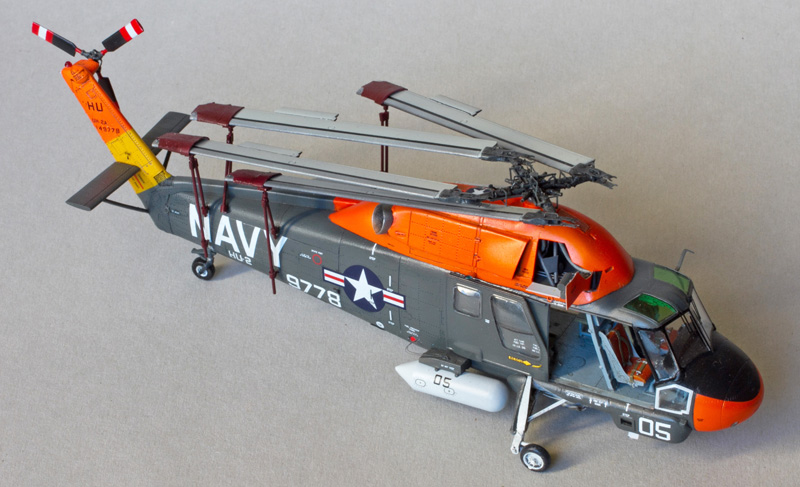
Kaman UH-2A Seasprite Model

1. Introduction
1.1. Aircraft
Kaman UH-2A Seasprite
Rescue and utility shipboard helicopter (information in Wikipedia)
U.S. Navy. BuNo 149778 / HU05. HU-2 squadron.
USS Forrestal (CV-59), at sea, 1964.


1.2. Story
A UH-2A Seaprite of Utility Squadron 2 aboard a U.S. Navy carrier is being prepared for a routine "plane guard" mission. Flight deck crewmen begin to unfold the main rotor blades. An NC-1A mobile electrical power unit is standing by to start the Seasprite's engine later on.

1.3. Model Kit
UH-2A Seasprite from ClearProp (kit # 72002), 1:72 scale.

2. Kit Overview
The ClearProp team deserves immense praise for tackling a subject not previously "kitted" in any scale, presumably with rather limited reference material, and for bringing us a model with very good overall accuracy and commendable level of detail out-of-the-box.
Features like full cockpit interior, cabin doors presented as separate parts, well-detailed rotor heads and landing gear are noteworthy.
The quality of molding is generally good, yet the plastic is not without some glitches such as visible seam lines and slight misalignment of halves.
There are some accuracy issues, all relatively minor:
- The assortment of various antennas (bulges, blades, etc.) on the fuselage bottom is not entirely correct for the UH-2A/B variant.
- The blue of the U.S. national insignia is not accurate on the decal – it is too light.
- Incorrect or insufficient recommendations on painting / colors are given in the instruction booklet (I will address this in section 3.2 of my article).

3. Construction
3.1. Building


This is the list of enhancements that I have made to what was in the box.
Firstly, we have to address a number of minor inaccuracies of the kit:
 1) The suit of antennas (bulges, raised panels, blades) on the fuselage bottom was corrected in accordance with historical photographs (such as this). I have sketched the correct configuration on a diagram given below.
 2) Excessively sharp creases were smoothed on the landing gear forward fairings and along some bulges of the engine compartment.
 3) Some spurious raised lines were removed from the left side of the aft fuselage.

Secondly, to get an accurately looking model you have to add a number of details – either simply too small to be molded in plastic, or just omitted in the kit:
 4) The cabin interior is good out of the box, yet the webbed seats must be thinned and the area below the instrument panel needs more detailing as it is clearly visible through the lower cabin windows.
 5) Several fuselage inlets and vents were cut out, with fine grilles placed over the openings where appropriate. Note that on the tail rotor shaft fairing the grilles must be vertical and not horizontal, as molded in the kit's plastic.
 6) Some improvements had to be made to the landing gear wells to mask the excessively visible seams between the plastic parts that comprise the wells.
 7) Brake lines were imitated on the main landing gear legs.
 8) Fuel lines were added, connecting the fuel tank pylons to the fuselage.
 9) Clearly seen gaps were ensured between the main rotor blades and their respective blade flaps, as it should be on a real Seasprite.
 10) As usual, external lights required considerable attention. These included the following:
   a) clear white navigation light and red anti-collision light on the tail rotor pylon fairing;
   b) ventral anti-collision light, clear red;
   c) a collection of four circular landing lights and floodlights in the lower forward fuselage, all clear white;
   d) clear red and green navigation lights, teardrop shapes on small pedestals each side of the engine compartment.
 11) Wire aerial was imitated. Normally it was stretched between the aft fuselage and the left horizontal stabilizer tip, but when the rotor blades were folded and their support rods were installed, it was apparently unhooked and hung along the fuselage side.

Finally, a fair amount of work was required to get the configuration that I wanted to have:
 12) The early Seasprite's retractable rescue hoist is a unique feature, so I wanted to showcase it – by scratchbuilding the hoist in the deployed position, obviously. This necessitated the scratchbuilding of the interior that is left visible by the opened rescue hoist hatch, and that required way more work than the hoist itself.
 13) As I intended to present my helicopter as being parked on the flight deck, the main rotor blades had to be folded, and required rotor blade support struts had to be scratchbuilt and attached.
 14) The Seasprite's main rotor blades are folded and unfolded manually, and the groundcrew need access to the rotor head while doing so. To facilitate this, the engine bay side panels open as platforms. And one of these panels, on the left side, I wanted to showcase as open and ready for the rotor unfolding procedure. Which inevitable meant that I had to scratchbuild the interior, including a part of the turbine and respective driveshafts.

3.2. Painting & Markings
As a prototype for my model I wanted a colorful Seasprite – with bright Red Orange hi-viz markings – covered by at least one good and clear historical photograph, and therefore I selected the BuNo 149778  assigned to the HU-2 in 1964. Here's the photo: link.

Here are some guidelines applicable to the Engine Grey-camouflaged single-engine Seasprites:
 - Interior: light bluish gray (most probably Light Ghost Gray); instrument panel: black; pilot seat cushions: orange-red; cabin webbed seats: khaki or light gray.
 - Top cabin windows: clear green.
 - Fuselage: Engine Grey (FS16081), with the following additional markings:
  -- Wide Orange-Yellow (FS13538) band across the tail rotor pylon.
  -- Between 1962 and 1965, Fluorescent Red Orange (FS28913) high-visibility markings were applied as follows: fuselage nose section, fuselage top section, tail rotor pylon (either full or from the Orange Yellow band upwards). From 1966 onwards, the Red Orange has disappeared from all "line" Seasprites (those serving in HU and HC squadrons that deployed on ships) and may have remained only on some of the shore station machines.
  -- Alternating diagonal stripes in red and yellow on one or both of the horizontal stabilizer planes – from 1965 onwards, on some machines only.
  -- Black anti-glare panel and "mask" around the front windows.
  -- Thin white outlines around the side windows on some machines – seek reference photos for your BuNo.
 - Wheel bay interior, main landing gear legs, wheel hubs: Insignia White (FS17875), most common by far, or Engine Grey – seek reference photos for your BuNo.
 - Tail landing gear leg: Engine Grey.
 - Antenna housings on the fuselage bottom: black, Radome Tan or Engine Grey – see my diagram for the most typical layout.
 - Engine exhaust pipe: dull steel / burnt metal.
 - Main rotor head and tail rotor head: Engine Grey (absolutely not "silver", as suggested by the kit's instruction).
 - Main rotor blades, top: Light Gull Grey (FS36440) with aluminum leading edge separated by a very clearly seen longitudinal black stripe.
 - Main rotor blades, bottom: black with aluminum leading edge.
 - Tail rotor blades, from hub to tip: red band, then black, then red, white and red stripes.
 - External fuel tanks: Insignia White or Engine Grey – seek reference photos for your BuNo.

It is worth noting that the U.S. Navy's Engine Grey is a "tricky" color. It looks quite differently under different lighting condition, and it appears that it also could change hue with weathering. Take a look at these historical photographs: photo 1, photo 2, photo 3, photo 4.
All these helicopters are absolutely standard and painted in the prescribed Engine Grey, although they look very differently due to lighting conditions and, possibly, due to different photographic film processing techniques.
Also note how on each of those photographs the Insignia Blue of the U.S. national insignia is invariably much darker than the Engine Grey of the helicopter fuselage. Which is as it should be – as opposed to the very light blue color that we see on the ClearProp's decal sheet (see, for example, here)

On my model, the national insignia decals came from a generic sheet by Techmod, while the rest of the markings are from generic Microscale decal sets. Only the small technical stenciling is used from the kit's decal.

3.3. Presentation
My small diorama is intended to replicate a generic fragment of a Forrestal-class carrier flight deck.
1) The flight deck surface is imitated with the use of sheet plastic, sandpaper and PE metal tie-down rings. 
2) The NC-1A mobile power unit is a kit produced by F4Models (cat. # 7006; long out of production). This purpose-built vehicle was a common sight on the U.S. carrier decks throughout the 1950s and 1960s.  
3) The flight deck crew figures came from several sources, such as Fujimi set #35001, Hasegawa set #X72-7 and Hasegawa F9F-8 kit. All of them underwent "plastic surgery".

 
4. Reference Data
[1] General information on the Kaman Seasprite in Wikipedia: link
[2] Picture galleries that contain some good historical photographs of the UH-2A/B variant: link and link  
[3] By browsing through the cruise books of the USN aircraft carriers available here, a thorough researcher will find quite a few historic photographs of the UH-2A/B variant. It's a hard work, but exciting and rewarding.

5. Notes 
5.1. Unfortunately, the Kaman Seasprite does not appear to be very popular among the aviation historians and writers: as of early 2022 (when I started this work), not a single book / monograph describing this versatile machine seemed to be available. For instance, there is a detailed 90-page book about the Bell HSL (a helicopter of no real significance, an abject failure), there are short but neat monographs on the Yakovlev Yak-24 and Kamov Ka-15/-18 (both little known and little used) – yet nothing dedicated to the Seasprite (208 built, in service for nearly 60 years and still counting).

Short articles in general reference books (e.g. "Illustrated Guide to Military Helicopters") and aviation magazines do exist. However, they do not usually spend more that a couple of lines on the early version of the Seasprite, concentrating instead on the SH-2F and G submarine hunters. So don't expect any service details, configuration notes, dimensions, drawings or photographs of the UH-2A/B in such books. Furthermore, you won't meet a single-engine Seasprite in any museum, and no walkaround-style photographs can be found. This is because, most probably, no single-engine Seasprites have survived: every frame was either converted to the later twin-engine version or lost in some accident.

Wikipedia article (already referenced above in section 4) offers a good overview of the Seasprite. Most of the other articles available on the Internet appear to repeat of rephrase the short excerpts from some of the general reference books, or simply to copy one another.

5.2. Like many aviation pioneers, Charles Kaman, the founder of Kaman Aircraft Corporation, strove to innovate. Although Kaman did not invent the intermeshing rotors, his helicopters utilizing this design were the first ones (and remain the only, as yet) to be in mass production and in successful operational service. As evaluation concepts, Kaman flew the world's first gas turbine powered helicopter (a modified K-225 model) and arguably the first unmanned helicopter. All of this is mentioned fairly often. But there is another innovation – not very important perhaps, but still curious – that appears to be forgotten: the Kaman UH-2A seems to be the first (and possibly the only) helicopter with a fully retractable rescue hoist (photo). Just like the retractable main landing gear, this feature was obviously incorporated to reduce drag. It did not survive for long, and the next variant of the Seasprite, the twin-engine UH-2C, was equipped with a conventional hoist, fixed externally. Yet the fact remains.

26 December 2021

Grumman XF5F-1 Skyrocket Model

1. Introduction
1.1. Aircraft
Grumman XF5F-1 Skyrocket
Prototype carrier-based fighter (information in Wikipedia)
U.S. Navy. BuNo 1442.
Grumman factory, Bethpage, USA, 1940.

1.2. Story
The XF5F-1 is being prepared for yet another test flight at the Grumman factory airfield. Its pilot is already in the cockpit. A ground crewman is standing by, close to the factory's improvised fire engine, a Cushman scooter.

1.3. Model Kit
XF5F-1 Skyrocket from MPM (kit # 72022), 1:72 scale.

2. Kit Review
My detailed review of the MPM's kit is available here.

3. Construction
3.1. Building
Although the accuracy of the kit is more or less acceptable out of the box, it really lacks details and requires quite a lot of wok to get a realistically looking model. I have added the following fully scratch-built items:
 1) Landing gear well interior. This was "guessworked", as no historical photographs are available.
 2) Landing gear legs and struts. 
 3) Landing gear door interior and hinges.
 4) Propeller hubs.
 5) Instrument panel and cockpit interior.
 6) Fuselage downward-vision window.
 7) Catapult bridle hooks.
 8) Clear external lights, including:
   a) Clear white dorsal and rear navigation lights.
   b) Red and green navigation lights – two wingtip ones plus two on the upper wing surface.
   c) Landing light and approach light on the starboard wing.
Then, bringing the model to a "definitive" short-nose XF5F-1 version required the following modifications to be done:
 9) Fuselage-to-wing fillets added.
 10) Rudder hinge lines revised (from straight ones to stepped ones).
 11) One long side-mounted exhaust stack per engine replaced with 9 smaller exhaust stacks.
 12) Small air intakes removed from the engine cowlings' lower lips.

Finally, a bit of aftermarket had to be added.
 13) This came in the form of two resin R-1820 engines from a set by QuickBoost (# 72059). I know that, technically, these engines are of the "wrong" version, but anything would be better than the sad pieces of plastic that came with the kit.

3.2. Painting & Markings
The top surface of the wing is Chrome Yellow (note that the yellow overlaps the leading edge). A careful study of historical photographs will tell you that this machine had its fuselage painted in Aluminium color and not in Naval Aircraft Grey, as prescribed by the Navy's official directives. The rest of the airframe is also Aluminium. The national insignia decals came from a generic sheet by Techmod, and the identification number decals are from various leftovers.

3.3. Presentation
There is a couple of well-known historic photographs that show the XF5F-1 on the Grumman factory field, sitting on the concrete in front of a hangar, being readied for a flight. It is this setup that I decided to replicate. So my diorama base and the fragment of that hangar front face were scratch-built from sheet plastic in accordance with those photographs.

The seated pilot figure is from a set # 721120 made by PJ Productions. Despite the name of that set ("US Pilots Seated WW2"), the figures' headgear is totally wrong for the period. I had to find a new head, and that came from an excellent set of standing USN pilot figures produced by CMK of Czech Republic (# 72115). The ground crewman figure is from another good CMK set (# 72110).

Cushman delivery scooters customized as "very light" fire engines have been in use on the Grumman's factory field: see this historical photograph. I scratch-built this tiny vehicle and added it to my little diorama.

4. Reference Data
[1] General information on the XF5F in Wikipedia: link
[2] Grumman XF5F-1 & XP-50 Skyrocket | Naval Fighters Series # 31 | Ginter Books, 1995.
[3] Grumman F7F Tigercat | Monografie Lotnicze Series # 1 | AJ-Press, 1991.